
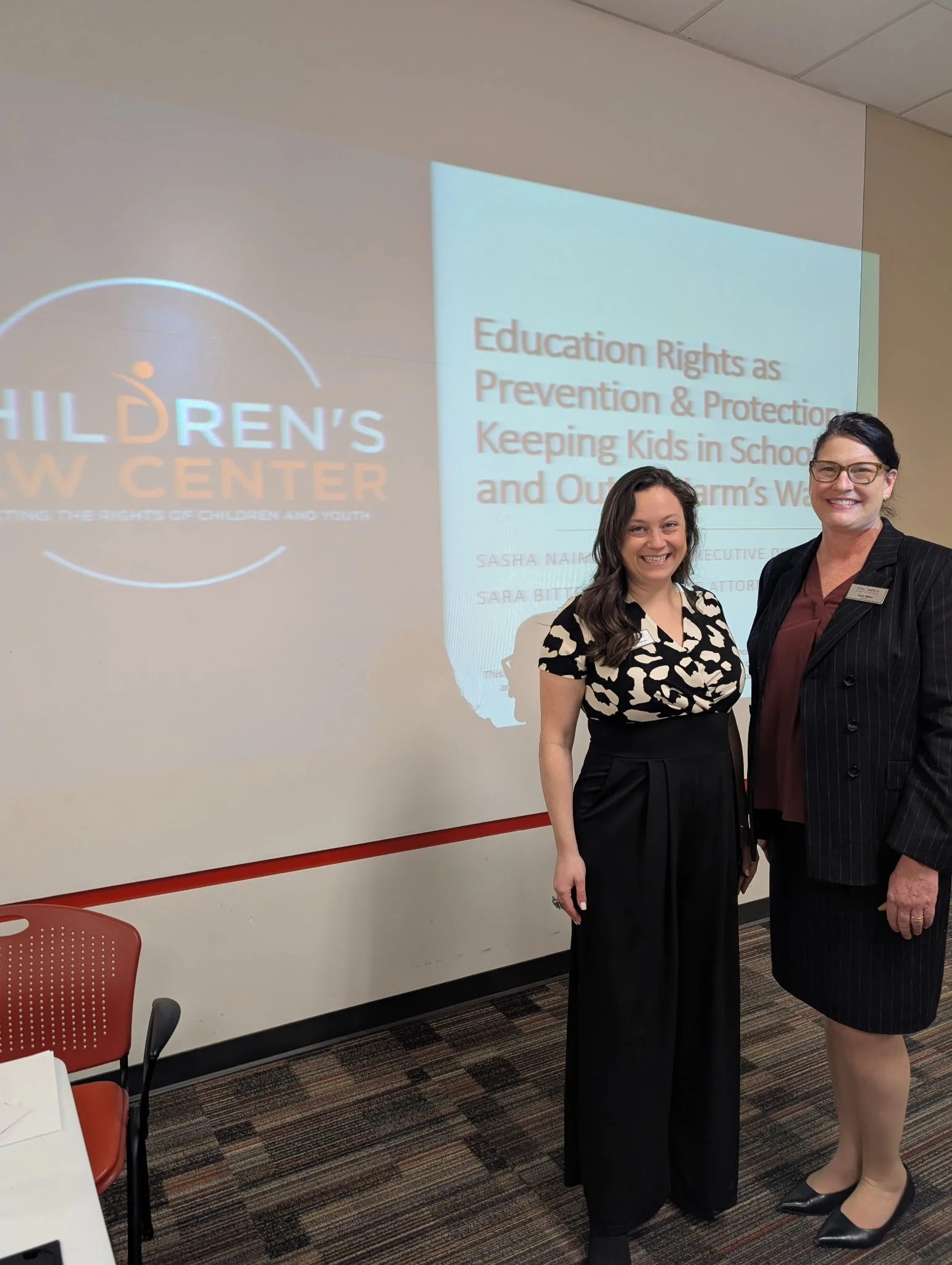
Sasha Naiman (Executive Director) and Sara Bitter (Attorney) present for Salvation Army’s Greater Cincinnati Human Trafficking Conference about “Education Rights as Prevention & Protection: Keeping Kids in School and Out of Harm’s Way.
For children who are survivors of human trafficking—and for youth at risk of exploitation—strong education protections can create safety, connection, and support during some of the most difficult moments of their lives. While education rights are sometimes discussed narrowly as a means to improve academic outcomes (an important goal!), this month we want to offer an additional lens.
Education rights increase protective factors proven to reduce the likelihood of trafficking and support recovery for survivors. These include:
Supportive, consistent relationships with trusted adults
Positive self-image and self-esteem
Coping, self-regulation, and behavior-management skills
Consent, refusal, and boundary-setting skills
Understanding healthy and safe relationships
Awareness of legal rights and available help
Having basic needs met (food, transportation, services)
Access to extracurricular activities and enrichment
Regular attendance, school stability, and continuity in learning
Improved academic and career pathways
Privacy protections that reduce re-traumatization
Throughout Anti-Human Trafficking Month, CLC attorneys have been teaching about education laws and policies that affect trafficked and at-risk children—including youth with disabilities or learning challenges, children experiencing housing instability, students in justice and child welfare systems, and immigrant students. A variety of federal laws, state laws, school/district policies, and other sources create important tools and strategies that anti-trafficking advocates should learn. If you weren’t able to attend one of our presentations, here are some key ideas.
1. Students with disabilities or learning challenges
“The intersection between disability and human trafficking can be cyclical. On the one hand, persons with disabilities are more likely to be targeted by traffickers; on the other hand, the experience of being trafficked can lead to or exacerbate existing disabilities through physical injuries or emotional trauma that in turn could heighten vulnerability.”
— U.S. Department of State, Office to Monitor and Combat Trafficking in Persons, 2024 Trafficking in Persons Report
For many trafficking survivors, as well as their children, trauma shows up in school as learning challenges, behavioral struggles, mental health needs, or physical health concerns.
Special education laws require schools to find, identify, evaluate, and support children with disabilities and learning challenges from birth through age 21—even when students move frequently or are not enrolled full-time. These protections can include classroom accommodations, specialized instruction, vocational training, and, for younger children, free early intervention (ages 0–3) and preschool services (ages 3–6).
Whether a child has an Individualized Education Program (IEP), 504 Plan, Behavior Intervention Plan (BIP), or other supports/modifications in school, consider asking for accommodations that could help human-trafficking survivors and children at risk of exploitation, including:
Flexible/extended time on assignments or tests
“Check in” meetings with trusted adult(s) to process in-school conflict, improving coping skills, self-esteem, etc.
Nonverbal cueing system (hand signal, sticky note) to redirect behavior
Pre-discussion before high-risk situations like assemblies, group work, or transitions
Explicit plan (instruction times, staff to help) for self-regulation and adjusting social responses
Predictable routines and clear expectations
Quiet space for calming down when overwhelmed
Permission for breaks during class or testing
Modified coursework or alternative ways to show learning
Trauma-informed communication tools teachers
Flexible attendance policies, excused absences for court, counseling, or safety needs
Intervention or compensatory education to address regression
Access to counseling or school-based mental health services
Incorporating particular, individualized mindfulness or grounding exercises into the day
Targeted behavioral or social-emotional goals, tracked with data
Transition planning for long-term stability
These supports are not about lowering expectations; they are about removing barriers, increasing safety, and giving survivors and at-risk youth opportunities to succeed.
2. Students experiencing homelessness or housing instability
The connection between human trafficking and housing instability is stark.
According to the National Network for Youth, at least 19% of runaway and homeless youth are victims of human trafficking—compared to less than 1% of youth overall. Even more concerning, 68% of youth who experienced trafficking, survival sex, or commercial sex were exploited while homeless. —National Network for Youth, Human Trafficking
An analysis of 2021 data from the National Human Trafficking Hotline shows that runaway/homeless status and unstable housing are among the top 3 risk factors for sex trafficking (out of 28 identified risk factors and vulnerabilities that applied to victims immediately prior to or at the time of entry into the trafficking situation). —Polaris Project, Analysis of 2021 Data from National Human Trafficking Hotline
When it comes to youth housing instability, one of the most important laws to know is the federal McKinney-Vento Homeless Assistance Act, which protects education access for children who lack a fixed, regular, and adequate nighttime residence. This includes students living in shelters, motels, transitional housing, cars, or other substandard or unstable settings.
Under McKinney-Vento and related laws, eligible students may have the right to:
Immediate enrollment in school, even without typical enrollment documents
Attend classes right away while paperwork is gathered
Continue receiving a free, appropriate public education (FAPE)
Remain in their school of origin or enroll in the local school, depending on the student’s best interest
Transportation support to and from the school of origin
Comparable educational services, including special education and English Learner supports
Free school meals
Every district and community school must have a McKinney-Vento liaison to help coordinate these supports. This liaison works with families, schools, and community partners to reduce barriers to attendance and stability—key protections for youth at high risk of exploitation. Look online for each Homeless Coordinator/Liaison by District at the Ohio Educational Directory System and Kentucky Department of Education’s Open House sites.
3. Students in the justice or child welfare system
Children do not lose their education rights because they are involved in the justice or child welfare system. Federal and state laws emphasize educational stability for these students, including in foster care and juvenile justice settings. These protections promote continued access to school, credit transfer, and educational services during detention, placement changes, or transitions back to the community.
For children in foster care, one of the most important protections can be to remain in their school of origin—the school they attended before moving to the foster care placement—unless a change is determined to be in the child’s best interest. The district of service is the public school district serving the area where the child is currently placed.
If staying in the school of origin is in the child’s best interest, the district of service generally must help arrange or fund transportation.
If a school change is best, the new district must immediately enroll the student, even if records or documentation are missing.
These protections can help reduce disruption, support healing, and help maintain trusted relationships with teachers and peers, particularly important factors for youth who have experienced trauma or exploitation.
4. Immigrant students
58% of child labor trafficking victims in the U.S. are foreign-born; 42% are U.S. citizens. —Understanding the Trafficking of Children for the Purposes of Labor in the United States 2024
54% of all trafficking victims—and 93% of labor trafficking victims—had recently migrated or relocated to the U.S., the top risk factor identified. —Polaris Project, Analysis of 2021 Data from National Human Trafficking Hotline
What increases trafficking vulnerability for immigrants and newcomers? Some issues are:
Trauma before or during migration
Limited English and unfamiliarity with U.S. systems/culture
Power imbalances (e.g., with employers, sponsors, schools, caregivers)
Family instability
Fear related to immigration status or authority figures
Immigration status does not limit a child’s right to attend public school. These students have rights and protections—that can aid youth at heightened risk of labor and sex trafficking—such as:
Free Appropriate Public Education (FAPE) regardless of immigration status
English Learner (EL) services in school
Equal access to all services offered to other students, including counseling, Advanced Placement/gifted classes, sports, and extracurricular activities)
Schools may not require disclosure of students’ or parents’ immigration status for enrollment
Privacy of their educational records (with limited exceptions)
* * *
Protecting students takes collaboration—school staff, families, child protection agencies, nonprofit partners, attorneys, advocates, courts, and the youth themselves all play a role. That’s why Children’s Law Center is here to help.
CLC provides free legal advocacy, community education, and policy work to ensure children’s education rights are not just theoretical, but they are real, enforceable, and protective.
We are proud to help reduce vulnerability to trafficking and support survivors as they rebuild safer, healthier futures.
-
Sasha Naiman, Executive Director & Attorney. Sasha joined the Children’s Law Center in October 2021. As a public-interest attorney and policy advocate, Sasha has deep experience serving vulnerable people in our region. She is especially passionate about providing legal representation, community education, and policy reform for youth in Ohio and Kentucky. Before joining the Children’s Law Center, Sasha was the Deputy Director of the Ohio Justice & Policy Center, where she worked for a decade, represented people in the criminal-legal system, and led organizational operations and strategies.
Sasha has been a member of multiple community and nonprofit Boards in Greater Cincinnati. She received her J.D. from Washington University in St. Louis and her B.A., magna cum laude, in English and Political Science from Boston University. During law school, Sasha worked for the St. Louis Equal Housing Opportunities Council, the Juvenile Rights and Reentry Clinic, and the U.S. Department of Justice’s Access to Justice Initiative (in Washington, D.C).